
TCS was the biggest loser in the Sensex pack, sliding 3.17 per cent, followed by HCL Tech, Yes Bank, IndusInd Bank, RIL, ICICI Bank, Infosys, Tata Steel, Kotak Bank and L&T, down up to 2.34 per cent.

HCL Tech was the top loser in the Sensex pack, skidding over 4 per cent, followed by Tech Mahindra Dr Reddy's, Wipro, TCS, Titan and Infosys. NSE Nifty plunged 167.80 points to 17,110.15.

Weakness in the rupee against the US dollar also weighed on domestic stocks. The local unit fell 11 paise to 70.60 against the US dollar intra-day.
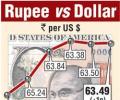
The rupee ended higher for the second consecutive week.

The 50-stock NSE barometer Nifty finished 14.75 points, or 0.14 per cent, down at 10,382.70 after shuttling between 10,340.65 and 10,393.15.

The rupee on Monday failed to maintain initial gains and ended lower by five paise at 60.21 against the dollar on fag-end demand for the US currency from banks and importers.

Equity benchmarks mustered gains for the first time this week on Thursday as investors piled into the recently-battered metal, bank and IT stocks amid expiry of monthly derivative contracts. Snapping its three-session losing streak, the 30-share BSE Sensex rallied 503.27 points or 0.94 per cent to settle at 54,252.53. On similar lines, the broader NSE Nifty gained 144.35 points or 0.90 per cent to end at 16,170.15.

Parliamentary Affairs Minister Prahlad Joshi has said that 31 bills will be taken up in the monsoon session. Among these include the Digital Personal Data Protection Bill, 2023.

'Given that the economy is going through a slowdown, further downward revisions of the 2019-2020 growth estimates cannot be ruled out,' notes A K Bhattacharya.
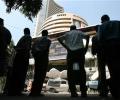
The 30-share Sensex ended up 12 points at 28,517 while the 50-share Nifty ended nearly unchanged at 8,660.

The printing of one-rupee notes was discontinued in 1994.
Increased demand for the dollar weighed on the local currency.

Both the indices closed at five-month highs, led by financial services, IT and metal stocks, amid persistent foreign fund inflows.

Air India had stopped the practice of issuing tickets on credit to government agencies for the travel of their officials in December last year because of accruing pending bills.

The rupee gained 28 paise on Thursday to close at 62.50.

All sectoral indices on the BSE and NSE ended in the red, led by realty, banking, metal, pharma, pharma and financial stocks.

Pharma major Sun Pharma remained the worst loser in the Sensex pack for the second day in a row after reports that regulator Sebi may reopen the insider trading case against the company.
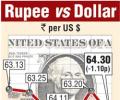
The local currency recovered some ground after the Reserve Bank of India (RBI) was said to have stepped in through state-run banks, helping the rupee to end at 64.30, a fall of 110 paise or 1.74 per cent.

PSU bank shares were the top gainers on hopes of a rate by the RBI on easing consumer inflation
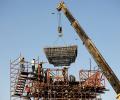
India's economy is unlikely to see double-digit growth and may grow between 8 per cent and 9 per cent this fiscal year (2021-22, or FY22), against the estimated 11.5 per cent, according to leading economists and rating agencies. The downward revision of growth projections to as low as 10 per cent is mostly on account of stringency in restrictions by states, relatively slow vaccination pace, and the possibility of a third wave of the pandemic. However, they say the impact will not be as severe as the first wave, and expect the first quarter to see positive growth.

Sajjid Chenoy, India economist at JP Morgan is the new part-time member.
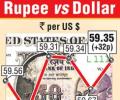
At the Interbank Foreign Exchange Market, the rupee resumed lower at 59.72 a dollar from the previous close of 59.67 and declined to a low of 59.88. It bounced back on dollar selling by exporters and some banks, touching a high of 59.30 before settling at 59.35, a rise of 0.54 per cent.

Sustained inflows of foreign funds supported the rupee

The dollar index was up by 0.43 per cent against a basket of six major currencies as euro dropped against the dollar, after quarterly economic reports from France and Germany missed expectations, said analysts.

The 30-share Sensex ended higher by 46 points at 26,360 and the 50-share Nifty gained 16 points at 7,891.

Mauritius is biggest route for investment into India.

Tata Motors was the top gainer on better-than-expected June quarter revenues

After a a steep fall last week, the rupee has closed slightly stronger against the dollar.

Inflation rate in fuel and power segment was (-)16.50 per cent.

Clouding the inflation outlook is the recommendation of the 7th pay panel for an average 24 per cent pay hike for millions of its employees, which would lift demand-driven price pressures.

A delay in US Federal Reserve's quantitative easing tapering, coupled with better-than-expected September quarter earnings, ensured FIIs kept foreign money flowing into Indian equities.

Inflation in food articles during June stood at 2.04 per cent, as against 1.13 per cent in May.

The BSE 30-share index after a positive opening stretched to 31,772.41, but could not stay there for long buffeted by the selling pressure. It hit a low of 31,562.25 before settling lower by 79.68 points, or 0.25 per cent, at 31,592.03.

The rupee got a boost as stock market investors cheered the Reserve Bank's steps. Fresh dollar sales by exporters amid sustained capital inflows also supported the local currency.

The 30-share Sensex closed down 115 points at 28,444 and the 50-share Nifty ended down 31 points at 8,524.

The NSE Nifty gained 77.85 points, or 0.71 per cent, to finish at 11,008.30. Intra-day, it shuttled between 10,821.55 and 11,035.65.
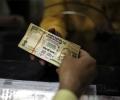
The rupee opened steady at 63.30 per dollar at the Interbank Foreign Exchange; but, firmed up to 63.22 before quoting at 63.23 per dollar at 1000 hours.

A query has been raised about the "missing" Rs 1.7 trillion fiscal hole in India's financial accounts. This is so because the Budget uses the revised estimates, a projection of how much the government was expected to earn, while the Economic Survey uses the first actual numbers.

After a volatile session, Sensex closed the day 563 points lower

Risk sentiment received a boost after eight core sectors grew to a five-month high of 4.9 per cent in August
 © 2026 Rediff.com - Advertise with us - Disclaimer - Privacy Policy - Sitemap - Feedback - About us - Terms of use - Grievances